
Before you start
- Public browsing needs no login; actual requests require an enabled account channel.
- Identify your application’s protocol and target task.
Applies to the interface reviewed on 2026-10-19 · Verification details
At a glance
- Choose the task and protocol before comparing prices.
- Compare up to three models; platform rates already include group multipliers.
- A catalog entry does not establish account-level availability.
Define the task first
Record the task, protocol, typical input and output lengths, and acceptance criteria. Open the English model catalog. Its price explorer supports search, channel selection and request estimates without sending a model request. Capability claims still need to be checked on the relevant model detail page.
Choose the same pricing basis
Choose Platform snapshot or Vendor reference. Platform rates already include the group and sale multipliers. The default chooses each model’s lowest input-rate group; it does not promise the cheapest complete task or prove that your key has access. Provider reference mode disables channel selection because those rates are a different billing basis.
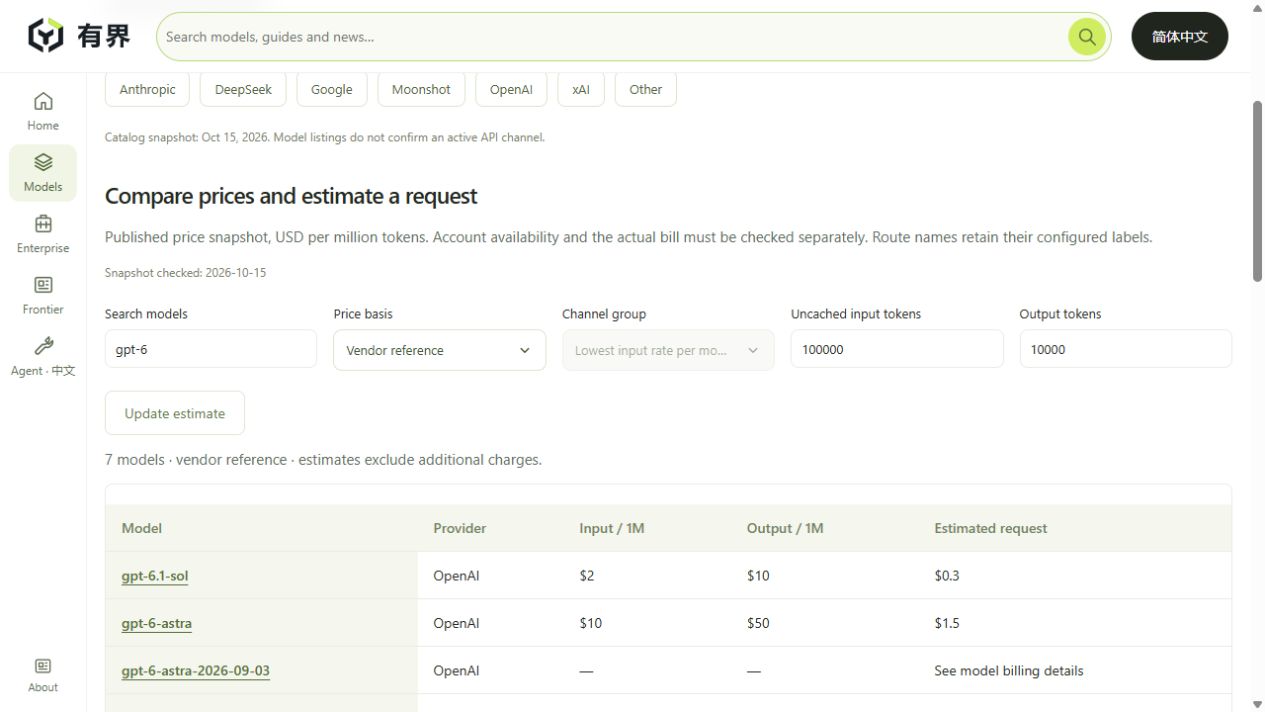
Search for an exact ID or a family such as gpt-6. All catalog records have a static table entry, so prices and detail links remain readable without JavaScript. Group labels retain their configured names, which can be Chinese.
Reproduce a request estimate
Enter 100,000 uncached input tokens and 10,000 output tokens, then select Vendor reference. For the documented standard rates in this example, Sol shows $0.30 and Astra $1.50: input/1,000,000 × input rate + output/1,000,000 × output rate. This local arithmetic was checked in the browser; it is not a paid API run or a comparison of output quality.
The image shows the actual English interface. Tier selection follows input length. Token estimates are enabled for reviewed text models; other models retain their rate information and direct you to billing details. Missing prices never become zero.
Understand what the estimate excludes
It excludes cache writes and reads, tools, other modalities, time-of-use adjustments, processing premiums and retries. An image or audio workload needs its own billing model. A pricing boundary also does not establish the context capacity of a model.
For advanced protocol filters and the three-model dialog, the Chinese interactive market remains available. It attempts to refresh database prices; the English explorer uses a clearly dated published snapshot. Compare equal sources and dates before interpreting a difference.
Inspect the model and test access
Open a model’s detail page for its sources, limits, pricing tiers, related analyses and small acceptance template. Configure a key with a suitable channel and quota in key management (Chinese interface). No public listing grants API access.
Continue with the first-request guide and usage review. Save the selected model, group, price basis and observation date alongside the actual bill and output acceptance result.
Sources & verification
Checked against the current interface and interaction implementation. No third-party installation or paid model evaluation was performed.
- Model market →有界 YOUJIE · Checked Oct 16, 2026
- English model pricing explorer →有界 YOUJIE · Checked Oct 19, 2026